The Certainty Trap
Why the Problem Was Never the God

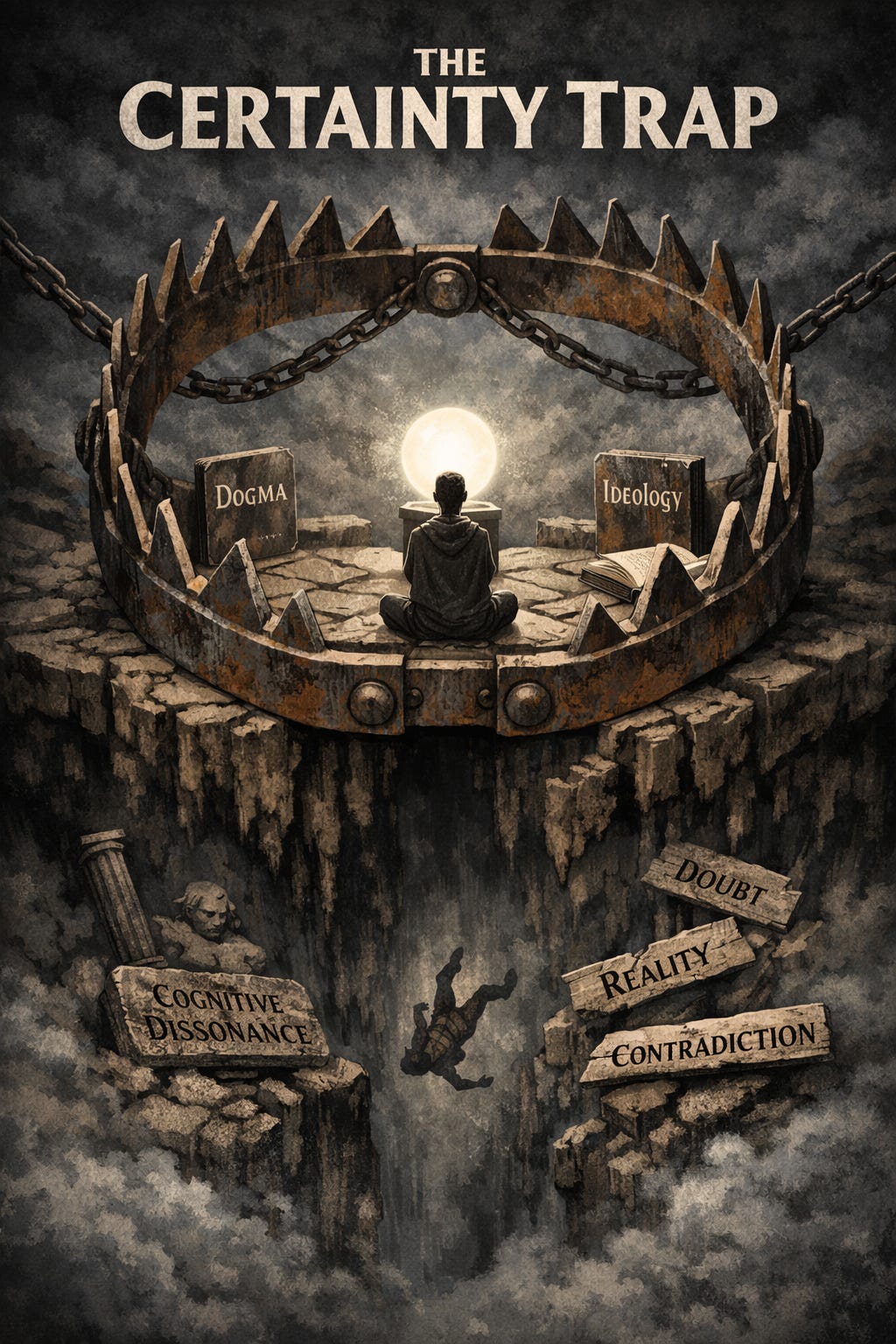
This is the first published essay from the CT-CV-EM-RD quartet. The other diagnostic members, The Captured Vantage and The Empty Man Does Not Exist, examine the same structural feature at the institutional-configuration and individual-cognition levels respectively: the institutional configuration that follows when the certainty demand described here is operationalised at scale by a captured personnel network, and the individual mind that mistakes its furnished and unaudited occupancy for the absence of belief. The present essay examines the philosophical substrate: the cognitive architecture that makes the certainty demand attractive to the human mind, the migration of the demand from religious to secular formations after the theological scaffold is abandoned, and the falsifiability criterion as the genuine dividing line between sceptical and dogmatic thinking. Each piece is self-contained. Read together, the three diagnostic panels describe a single structural feature operating at three levels of magnification: the philosophical substrate beneath the certainty migration, the institutional configuration the substrate produces under conditions of factional power, and the individual cognition in which the substrate is housed; beneath all three, The Residue of Doubt Itself supplies the reflexive-discipline substrate that completes the quartet.
INTRODUCTION
There is a question that the modern sceptical tradition has, on the whole, declined to ask of itself. It concerns not the existence of any god but the nature of the mechanism that made gods possible in the first place. The standard account holds that religion is the problem: a pre-scientific inheritance, an irrational attachment to the supernatural, a system of social control dressed in metaphysical costume. Remove the religion, the account implies, and the irrationality dissolves with it. What remains is a reasoning animal, finally at liberty to examine the world without the distortions of revealed faith.
This account is wrong. Not wrong in every particular, religion has produced and sustained extraordinary irrationality, but wrong in its diagnosis of what generates the pathology. The problem was never the god. It was the certainty. And certainty, unlike god, does not disappear when the theological framework that housed it is abandoned. It migrates.
The present essay examines that migration. It does so through seven related lines of inquiry: the psychological substrate that makes certainty attractive to the human mind; the formal mechanism by which ideological vacancies are generated, amplified, and filled; the case studies that secular history provides of religious structures rebuilt without religious vocabulary; the orthodoxy that New Atheism constructed in the very act of opposing orthodoxy; the criterion of falsifiability as the genuine dividing line between sceptical and dogmatic thinking; scientism as a dogmatic mode that scientific rhetoric can conceal; and the particular danger of moral certainty, which is the most consequential and least examined form the pathology assumes.
The essay closes with a distinction that the preceding argument makes necessary: between atheism, which is a position on a question, and scepticism, which is a method for holding all positions. These are not synonyms. The confusion between them has cost the sceptical tradition much of its intellectual credibility, and the cost is still accumulating.
I. THE PSYCHOLOGICAL SUBSTRATE
The case for religion, at its most honest, has never been purely theological. It has been psychological. What religion delivers, beneath its doctrinal surface, is a structured resolution to conditions that the unassisted human mind finds intolerable: the contingency of existence, the opacity of death, the apparent arbitrariness of suffering, and the demand that social life make sense. These are not problems that evidence resolves, because they are not primarily empirical problems. They are existential ones. And the mind that confronts them without support is a mind under a burthen that few philosophical temperaments can sustain indefinitely.
The neurological and psychological literature on this point is substantial. Terror management theory, developed by Greenberg, Solomon, and Pyszczynski from Ernest Becker’s foundational work in The Denial of Death, holds that a significant portion of human cultural activity, including religious belief, is organised around the suppression of mortality salience: the awareness that one will cease to exist. Becker’s central claim was that civilisation itself is largely a system for managing the terror that this awareness produces. Religion, in this reading, is not a mistake but a solution, a solution that trades accuracy for psychological stability, but a solution nonetheless.
Cognitive science adds a further dimension. The human mind is, as Pascal Boyer’s research on the natural foundations of religious belief demonstrates, constitutively prone to agent detection, to teleological reasoning, and to the attribution of intention to events that have none. These are not cognitive malfunctions. They are adaptations that served early human populations well in an environment where false positives were cheap and false negatives were lethal. The cost was a mind that generates supernatural explanations spontaneously and finds them intuitively satisfying.
What matters for the present argument is this: the psychological infrastructure that makes religious belief attractive is prior to any specific religion. It is not produced by theology; it produces the conditions in which theology becomes credible. The demand for certainty, for a stable, comprehensive account of how things are and why, one that does not dissolve under pressure, is a feature of the cognitive architecture itself. Theology is one answer to that demand. It is not the only one.
This is the point at which the standard atheist critique begins to fail. The critique targets the answer whilst leaving the demand intact. And a demand that has not been addressed does not disappear. It seeks resolution through whatever materials the cultural environment makes available.
II. THE VACANCY MECHANISM
The Vacancy Mechanism is a formal account of the process by which the removal or collapse of a certainty structure does not produce scepticism but produces a state of heightened susceptibility to ideological capture. It proceeds in three stages, and it operates as the explanatory engine beneath every subsequent section of this essay.
The first stage is vacancy generation. A certainty structure, whether theological, political, or cultural, is destabilised. The destabilisation may be gradual, as in the long erosion of institutional religious authority in Western Europe across three centuries; or it may be acute, as in the revolutionary dismantling of a political order. What defines this stage is not the intellectual defeat of the old structure but the withdrawal of its psychological function. The individual or collective that depended upon it for identity anchoring, moral orientation, and existential resolution is left without that function. The vacancy is not primarily intellectual. It is structural.
The second stage is vacancy amplification. The absence of a certainty structure does not, in the great majority of cases, produce philosophical equanimity. It produces anxiety. That anxiety has several characteristic expressions: an intensified search for meaning and affiliation, a heightened responsiveness to authoritative or comprehensive explanatory systems, and a lowered threshold for ideological commitment. The amplification is social as well as individual. Communities in the vacancy stage exhibit increased cohesion around nascent belief systems, elevated intolerance of internal dissent, because dissent threatens the provisional structures that are beginning to form, and a recruitment logic that prizes commitment over accuracy. The vacancy is doing active work. It is selecting for the features of the system that will fill it.
The third stage is ideological capture. A new structure fills the vacancy. The new structure need not resemble the old one in content; it need only perform the same psychological functions. It must provide identity, community, moral clarity, a comprehensive account of the world, and a mechanism for managing the anxiety that the vacancy generated. Historical theology is not a prerequisite. What is required is structural isomorphism: the new system must be held with the same absolute quality as the old.
Three consequences of the Vacancy Mechanism are directly relevant to this essay. First, it explains why the removal of religion does not, in the historical record, reliably produce scepticism. The vacancy generates a demand that scepticism, by its nature, cannot satisfy, because scepticism is a method for managing uncertainty rather than eliminating it. A framework that tells you what you do not know is not competitive with one that tells you what you do. The vacancy amplification stage tilts the selection sharply towards the latter.
Second, the Vacancy Mechanism predicts that secular ideological movements will replicate the pathological features of the religious systems they displace, not because their adherents are insincere but because the mechanism that drives capture selects, specifically, for certainty-providing features. The content is variable. The structural requirements are constant.
Third, the mechanism identifies the moment of maximum danger: not the stable religious state but the vacancy stage itself, in which the appetite for capture is at its highest and the critical faculties are at their most compromised. A population that has recently lost one certainty structure is not a population poised for rational self-governance. It is a population in acute psychological need of a replacement. History has rarely failed to provide one.
One refinement of this third point is worth marking, because the opening the vacancy stage produces is not a thing into which a population merely drifts. A lowered threshold for commitment and a compromised critical faculty describe, from the supply side, the condition of least resistance to capture, and least resistance is precisely what an actor positioned to steer the replacement will find and exploit. The Psychopathic Capture Effect names the sibling mechanism here: institutional nodes of power are occupied, at preferential rates, by those most willing to instrumentalise others towards the acquisition of power, and such an actor meets, in the vacancy stage, a population whose ordinary resistances are at their lowest. The vacancy does not create the actor, who is present at some background rate in any period; it lowers the cost of his success. Two clarifications keep this within the structural account rather than collapsing it into a theory of bad actors. First, the capture still succeeds by structural function and not by the actor’s design: the replacement that fills the vacancy prevails because it performs the psychological work the vacancy demands, and an opportunist who supplies a structure that fails to perform that work captures nothing. Second, the opening is exploited as readily by the sincere zealot as by the cynic, since the mechanism selects for the structure’s fit to the vacancy and is indifferent to the motive of whoever supplies it. The actor is therefore an accelerant of a process the vacancy has already set in motion, never its cause.
The intensity of vacancy amplification, and of the capture that follows, is not uniform, and the mechanism is the more falsifiable for saying so. Its realised severity varies with three conditions, each of which can be specified before the capture is observed rather than inferred from it. The first is the acuteness and speed of the prior structure’s collapse: a certainty structure that erodes across generations leaves residual buffers in place that an abrupt revolutionary rupture destroys at a stroke, and the slower gradient is a fact about timing that may be measured without reference to whatever capture follows. The second is the depth of the prior psychological dependence on the dismantled certainty: the more completely a population had vested its meaning, belonging, and account of death in the structure that has fallen, the more acute the appetite the vacancy leaves. The third is the presence or absence of competing structures that perform the same psychological work without demanding the same surrender, a constitutional order that constrains the totalising claim, communal and familial institutions intact enough to supply belonging, and reservoirs of identity and purpose on which a person may draw without enlisting in a replacement creed. Post-war Northern Europe is the instructive case: its secularisation unfolded across generations rather than in a single rupture, and its constitutional and communal institutions remained intact throughout, two conditions observable independently of the outcome, and the capture dynamics there were correspondingly attenuated. The mechanism accordingly does not predict uniform ideological takeover wherever religion recedes. It predicts a heightened susceptibility whose realised intensity these conditions govern, and it is refuted not by the existence of a low-capture secular society but by the appearance of intense capture where all three conditions counsel against it, or its absence where all three predict it. This moderator structure operates at the prior stage to the scale dynamic set forth above: the conditions here govern how acute the initial vacancy and its capture will be, whilst the Oppositional Inheritance Pattern governs how a movement, once underway, reconstructs at scale the instruments of the orthodoxy it opposed. The one concerns the depth of the opening; the other, the shape of what grows to fill it.
III. SECULAR RELIGIONS: CASE STUDIES IN IDEOLOGICAL CAPTURE
The observation that certain secular movements exhibit religious characteristics is not original to this essay. Eric Hoffer documented it in The True Believer in 1951. Raymond Aron applied it specifically to Marxism in The Opium of the Intellectuals. Hannah Arendt’s anatomy of totalitarianism charted the eschatological structure of both National Socialism and Soviet Communism with rigorous precision. The observation has become, in certain quarters, a commonplace.
What it has not become is a properly structural diagnosis. The point is not that secular movements sometimes deploy religious language or that their adherents are emotionally invested in ways that parallel religious devotion. The point is that the Vacancy Mechanism predicts, with specificity, which features a replacement certainty structure will exhibit, and that the secular movements that arose in the wake of European dechristianisation exhibit those features with a consistency that is too systematic to be coincidental.
Consider Marxist-Leninist communism as the most extensively documented case. The sacred texts are identifiable: the Marxist corpus occupies the role of revealed scripture, with Das Kapital as the incontrovertible foundational document. The heresy mechanism is explicit: ideological deviation is not treated as an intellectual error subject to revision but as a moral failing, a betrayal of the collective, an existential threat to the community, the same conflation of epistemic and moral categories that doctrinal heresy has always required. The martyrology is elaborate, the eschatology intact, and the institutional structure mirrors the church with structural fidelity: a hierarchical body with interpretive authority, a cadre of initiates distinguished from the laity, and a practice of public self-criticism structurally identical to the Catholic sacrament from which it almost certainly derives.
The Vacancy Mechanism is visible in the historical sequence. The populations most susceptible to communist capture were precisely those in which traditional religious structures had been disrupted: by industrialisation, by deliberate state secularisation, or by the cultural upheaval of the 19th century. The vacancy preceded the capture. The mechanism then ran its predicted course.
The pattern is older than Marxism-Leninism, and naming an earlier instance demonstrates that the structural mechanism is recurrent rather than tied to any single ideological content. The Jacobin moment of 1793–1794 supplies the case. The sacred texts are identifiable: Rousseau’s The Social Contract and the Discourse on Inequality function as foundational scripture, cited and invoked with a fidelity that earlier theological controversies would have recognised, and the Declaration of the Rights of Man and of the Citizen operates as the doctrinal symbol the regime is constructed to enforce. The sacralisation is explicit rather than implicit: the Cult of Reason in late 1793 and the Cult of the Supreme Being installed by Robespierre in 1794 were not metaphors for political devotion but formal state religions, complete with festivals, altars, and liturgical apparatus, designed to occupy the institutional space the dechristianisation campaign had emptied. The heresy mechanism is explicit: dissent from the revolutionary programme was prosecuted by the Committee of Public Safety as a moral failing rather than as a political disagreement, and the revolutionary tribunals operated with the ecclesiastical court’s structural form, including summary procedure and the absence of meaningful appeal. The eschatology was intact: the Republic of Virtue was the terrestrial salvation towards which the revolution was directed, and the Terror was the necessary purification by which that salvation would be achieved. The Vacancy Mechanism is visible in the historical sequence here as well: the dechristianisation campaign of 1792–1793 produced the structural vacancy that the cults of Reason and the Supreme Being were constructed to fill, within months rather than decades. The recurrence of the pattern across more than a century, between the Jacobin moment and the Bolshevik moment, with structurally identical features arising in populations of widely different cultural composition, is itself the evidence that the mechanism operates structurally rather than as a local accident of one revolutionary tradition.
The No True Scotsman mechanism, which identity-defence reasoning of this kind invariably produces, merits particular attention here. When the failures of a secular religion are presented to its adherents, the most common response is not revision of the framework but quarantine of the counterexample: that was not real communism; that was a perversion of the original vision; those who enacted those atrocities had betrayed the cause. This is not a logical argument. It is an identity-protective manoeuvre that restructures the claim such that no counterevidence can reach it. The move is identical to the theological strategy that insulates religious doctrine from falsification by historical atrocity: the Inquisition was not real Christianity; those were men who betrayed the faith.
What the No True Scotsman move reveals is that the system in question is not held as a falsifiable hypothesis but as an identity anchor. The function has displaced the content. This is precisely what the Vacancy Mechanism predicts: capture succeeds when the new structure performs the psychological function of the old one. The certainty is doing the work. The doctrinal claims are secondary.
There is a further structural dynamic that amplifies this problem, and it operates at the level of scale. Any coordinated solution that achieves sufficient scale tends to recreate the pathology it was constructed to solve. This is not a contingent feature of specific movements; it is a predictable consequence of the mechanism’s selection criteria. A community formed around opposition to dogmatic authority must, as it scales, develop the very instruments it opposes: authoritative texts, interpretive hierarchies, boundary mechanisms for policing membership, and an internal logic that protects the group’s certainty structure from revision. The success of the movement is, in this sense, the condition for its corruption.
The reason the instruments reappear is worth stating precisely, because without it the dynamic reads as mere irony rather than as structure. At small scale, a movement coheres on shared conviction alone: the members know one another, disputes are settled face to face, and the boundary of the movement is maintained by acquaintance. Past a threshold of numbers and distribution, none of this remains available. The threshold is not arbitrary, and naming it converts the observation into a mechanism. A bounded mind can hold only so many stable relationships in working acquaintance, a ceiling that the empirical literature locates at Dunbar’s number, a few hundred persons, beyond which the relational knowledge that coordinated a small group by personal familiarity can no longer reach across the whole. This is the relational limit the framework elsewhere names the Cognitive Governor: the bounded coordination capacity of the human mind, the proximate reason a structure cannot hold itself together by acquaintance once it exceeds the ceiling. A movement that grows past it does not choose to formalise; it must formalise or dissolve, because the cognitive substrate that carried coordination at small scale is exhausted, and the instruments are what remain. Disputes that can no longer be settled in person require an authority to settle them, and the authority requires a text; the text requires interpreters, and the interpreters become a hierarchy; the membership, grown too large to police itself by acquaintance, requires a mechanism that marks who belongs and who does not. Each instrument is adopted for a reason that is locally rational and, at the moment of adoption, invisible as a betrayal of the founding posture. And each is identical in function to the apparatus the movement was formed to oppose. This is the structural point the irony conceals: the opposition does not precede the construction and then lapse into it. The opposition, conducted at scale, is the construction. To oppose an orthodoxy with enough coordinated force to displace it is to build the instruments by which an orthodoxy is maintained, because those instruments are what coordinated force at scale requires.
This is the Oppositional Inheritance Pattern, and naming it guards against the misreading it most often attracts. When a movement that defined itself against an orthodoxy is shown to have reproduced the orthodoxy’s features, the reflexive charge is hypocrisy: the members failed to honour their stated principles. The charge mistakes the nature of the inheritance. The inheritance is structural rather than attitudinal. It does not arise from a lapse of sincerity that more vigilance would have prevented; it arises from the coordination requirements of scale, which would impose the same instruments upon the most sincere movement imaginable. An accusation of hypocrisy, treating the inheritance as a personal moral failure, cannot dissolve it, because the inheritance was never lodged in the persons. It was lodged in the structure they were obliged to build. Where the opposed structure has not merely been resisted but has collapsed, the pattern compounds with the Vacancy Mechanism: the vacancy left by the fallen orthodoxy is filled, and the materials nearest to hand for filling it are the very materials the movement inherited from what it opposed.
IV. NEW ATHEISM’S OWN ORTHODOXY
The New Atheist movement, which attained its peak cultural influence in the first decade of the 21st century, merits careful examination, and not the contemptuous dismissal it sometimes receives from those who ostensibly share its sceptical commitments. The individuals who advanced it were serious thinkers. Their critique of religious irrationality was, in many respects, accurate. The problem was not located in the arguments they produced. It was located in the mode by which those arguments were held and transmitted, and in the community that formed around them.
Richard Dawkins, Christopher Hitchens, and Sam Harris, together with Daniel Dennett, produced a body of work that combined legitimate scientific and philosophical critique of religious claims with a rhetorical architecture that reproduced, with structural fidelity, the very architecture it opposed. Dennett’s posture differed from the other three in one respect that is worth specifying rather than leaving as a generality: his treatment of religion in Breaking the Spell (2006) was framed as a research-programme proposal to subject religious phenomena to naturalistic study, rather than as a polemical refutation of theistic claims. He shared the movement’s sceptical commitments and was identified as one of its principal figures, but the rhetorical mode he adopted was less confrontational and more investigative than the modes Dawkins, Hitchens, and Harris adopted. The structural critique that follows applies to the movement as a whole; the differential intensities at the level of individual figures are noted here so that the analysis is not read as homogenising distinctions the historical record preserves.
The movement developed functional equivalents of sacred texts: works treated less as provisional arguments than as identity-bearing authorities. The God Delusion, God Is Not Great, and The End of Faith function within the community as foundational documents of authority. They are cited, quoted, and defended rather than subjected to sustained internal critique. The internal debate that did emerge, most notably the accommodationist dispute, was treated not as a legitimate methodological disagreement but as a form of capitulation. The accommodationist was not merely wrong; the accommodationist had betrayed the cause. This is not the logic of sceptical enquiry. It is the logic of doctrinal heresy. The structural resemblance to the religious community’s treatment of theological dissenters is not superficial. It is categorical.
The evangelical mode is equally evident. The goal of New Atheist rhetoric was not merely to present arguments for the consideration of a reasoning public. It was to produce conversions, a word the movement’s own figures used without apparent irony. The adoption of the “brights” designation as a self-congratulatory taxonomy, the confident prophecy of religion’s imminent demise under the pressure of scientific advance, the contempt not merely for religious believers but for those who declined to share the movement’s certainty: these mirror with precision the evangelical confidence of the traditions it opposed. The certainty had not been eliminated. Its object had been changed.
This is the Vacancy Mechanism operating within a nominally sceptical movement. The New Atheist community, for a substantial proportion of its adherents, was performing the functions of ideological capture: identity anchoring, community provision, moral clarity, and the management of existential anxiety through a comprehensive explanatory framework. The framework’s content was secular and scientific. Its mode was doctrinal.
There is no personal failing to impute here. The Vacancy Mechanism does not require bad faith. It requires only that the psychological demand for certainty remain unaddressed and that a community form around conclusions rather than around a method. The selection pressure for commitment over accuracy, the identity investment in foundational claims, the reclassification of dissent as disloyalty, all emerge from the mechanism, not from the character of the individuals involved. Dawkins and Harris are not being accused of dishonesty. They are being identified as instances of a pattern older and more powerful than either of them.
That pattern is the Oppositional Inheritance Pattern described in the preceding section, and the New Atheist case displays it in its purest form. The movement did not construct its orthodoxy after the work of opposition was done, in some later phase of complacency or decline. It constructed the orthodoxy in the very act of opposing one. The foundational texts treated as authorities, the reclassification of the accommodationist as a traitor rather than a colleague in error, the evangelical drive to produce conversions, the taxonomy of the enlightened against the benighted: none of these was a departure from the campaign against religious dogma. Each was an instrument of that campaign. To oppose the dogma at the scale the movement sought required exactly the apparatus that constitutes a dogma, and so the apparatus was built, not in spite of the opposition but as its very means. This is why the resemblance between the New Atheist community and the religious community it opposed is categorical rather than incidental. The two were solving the same coordination problem with the same instruments, and the instruments do not change their structure according to the content they coordinate.
V. FALSIFIABILITY AS THE REAL DIVIDING LINE
The standard taxonomy of the debate between religion and atheism is organised around the question of belief: one either affirms the existence of a god, or denies it, or suspends judgement. This taxonomy is not without utility. But it misidentifies the significant distinction. The significant distinction is epistemological, not ontological. It concerns not what one believes but how one holds one’s beliefs.
Karl Popper’s criterion of falsifiability was advanced as a demarcation criterion between science and non-science. A claim is scientific, in Popper’s formulation, if it is structured such that some conceivable observation could demonstrate it to be false. A claim so constructed that no observation could touch it is not scientific, regardless of how it presents itself. Popper applied this criterion primarily to theories of nature. But the logical structure of the criterion is not confined to natural science. It applies to any claim that purports to describe how things are.
The criterion has force for a reason that must be stated rather than assumed, because the reason marks the boundary at which the criterion ceases to apply. A bounded observer does not survey reality from outside it. There is a limit, physical in origin and indifferent to the substrate of the mind that meets it, beyond which knowledge is not deferred but structurally foreclosed: a horizon past which no observation, however refined, can reach. This limit is itself advanced here as a motivating hypothesis grounded in confirmed physics rather than as a secure foundation exempt from the discipline the essay demands of everything else; it is held falsifiably, on the same terms as the rest. What it establishes, held so, is the distinction upon which the falsifiability criterion depends. A claim that lies on this side of the horizon is one the evidence can still reach, and the criterion applies to it with full force: it must say what we should expect to observe, and pay its debt when the observation refuses. A claim that lies beyond the horizon is of a different kind. It cannot be tested, because the boundary forecloses the testing, and it can therefore neither pass the criterion nor fail it. The error the criterion is built to expose is not the holding of trans-horizonal claims, which a finite mind can scarcely avoid, but the practice of holding such a claim with the confidence that only a tested claim has earned, of carrying a conviction past the edge where the evidence cannot follow and then awarding it the standing that evidence this side of the edge confers. To be beyond the reach of testing is not to have withstood the test. The unfalsifiable claim is not thereby vindicated; it is merely placed where vindication cannot arise, and the dogmatic mode begins precisely at the point where that placement is mistaken for a passing grade.
Applied to belief systems, the criterion produces a division quite different from the theist/atheist one. A theistic belief held provisionally, as the best current account of the evidence as the believer understands it, with genuine openness to revision in the light of counterevidence, is epistemologically closer to a sceptical position than an atheistic belief held as a certainty that no evidence could revise. The former holds a position as a hypothesis. The latter holds a position as an identity. The content of the positions is less significant, epistemologically, than the structure in which they are held.
This is not merely a theoretical observation. Certain theological traditions have maintained the falsifiable posture with rigour. Process theology, various strands of apophatic theology, and the tradition of theological scepticism extending from Maimonides through Kierkegaard exhibit, at their most disciplined, an awareness that theological claims are provisional approximations rather than certain descriptions. One need not find these traditions persuasive to observe that their epistemological posture is distinguishable from the dogmatic certainty that characterises the institutions most commonly under sceptical attack. The sceptic who cannot make this distinction is not being rigorous. He is being incurious.
The real dividing line is between those who hold their most important convictions as falsifiable and those who do not. This line does not map onto the theism/atheism axis. It cuts across it. A scepticism that fails to recognise this, that treats atheism as the terminus of rational enquiry rather than as one position subject to the same epistemological standards as any other, has not understood what scepticism is. It has adopted the vocabulary of the method in the service of a conclusion, and thereby committed the precise error it was designed to prevent.
VI. SCIENTISM AS A DOGMATIC MODE
There is an important distinction, frequently elided in discussions of the religion-versus-science debate, between science as a method and scientism as an ideology. Science, in the former sense, is a disciplined set of practices for generating falsifiable claims about the natural world, testing them against observation, and revising them when the evidence requires. It is the most reliable method humanity has devised for producing knowledge about empirical questions. This is not in dispute here, and it is not what requires examination.
Scientism is the claim that science so defined is the only legitimate source of knowledge about any question, and that any domain of enquiry that does not conform to its methods is either reducible to it or without genuine cognitive content. This is a philosophical claim, one that the scientific method itself cannot adjudicate, since the question of what constitutes a valid source of knowledge is a question of epistemology, not of natural science. Strong scientism is, in this sense, self-refuting: it cannot be established by the method it privileges, and its denial would not constitute a scientific falsification of anything. The claim that only scientific claims are meaningful is not itself a scientific claim.
This matters because New Atheism, and a significant strand of contemporary scepticism, regularly slides from the first sense to the second. The move is understandable: if one has correctly identified religious irrationality as a serious problem, and if one has found in scientific method a reliable corrective to that irrationality, the generalisation of that corrective to all domains carries a certain psychological momentum. But the generalisation does not follow logically. And the slide from science to scientism produces precisely the dogmatic structure that the scientific method, properly understood, is designed to prevent.
The specific failure of scientism is its treatment of questions that are not empirical as questions that are either unanswerable or already answered by implication. Questions of value, of meaning, of ethical obligation, and of metaphysical interpretation are not scientific questions. This does not make them questions without content or without rational methods of investigation. It makes them questions that require different tools. A framework that denies the legitimacy of those tools is not more rational than one that acknowledges them. It is less rational, because it has restricted the scope of its own enquiry without justification.
Scientism is the certainty trap applied to science’s own instrument. The conversion of a reliable method into an absolute is not a scientific conclusion. It is a Vacancy Mechanism output.
It would be a comfortable error to suppose that scientism is therefore a single thing, the posture of the layman who reveres science without practising it, and that the institutions of science are themselves immune to the pathology because they hold the method in their hands. They are not immune. The apparatus that produces and certifies scientific knowledge, the journals, the funding bodies, the advisory panels, the official consensus, is composed of human beings subject to the same incentives, the same fear of heresy, and the same coordination pressures that this essay has traced through every other certainty structure, and it is therefore capturable in precisely the manner those pressures predict. When it is captured, what issues from it is not the layman’s imitation of science but scientism bearing the genuine credential: a claim that carries the full institutional authority of the discipline and yet has been shaped, at the decisive moment, by pressures that are not epistemic. This is the more dangerous form, because the credential is real and the dissent is therefore the more easily condemned. A directive to defer to the consensus, issued in a register that forecloses the asking of the question, is identical in structure to the older directive to defer to the Church; the vocabulary has changed and the foreclosure has not. The reader will not want for a recent and consequential instance in which official scientific authority was invoked to settle questions that remained open, and in which those who pressed the open questions were treated as heretics rather than as colleagues in honest doubt; the instance is contested, and the structural point does not depend upon any particular reading of it.
It is essential to state what this does and does not imply, because the temptation here is to commit the mirror of the error. To observe that the institutions of science are capturable is not to indict the method; it is to defend the method against the institutions when they betray it. Capture is not the operation of falsifiability but its suspension, the moment at which a question that the method would keep open is closed by authority. The remedy is therefore not less science but more of the discipline that scientism abandons: the capture is itself detectable by the method, visible in the predictions that failed and were not retracted, in the dissent that was answered by sanction rather than by evidence, in the consensus that could name no observation that would have moved it. The one who defends the open question against the captured institution is not the enemy of science. He is its only faithful party, holding the instrument steady whilst those who hold its prestige have abandoned it.
VII. THE MORAL CERTAINTY PROBLEM
Of all the forms that certainty assumes, moral certainty is the most consequential and the least examined within the sceptical tradition. Metaphysical certainty is regularly challenged. Political certainty attracts sustained critique. Moral certainty, perhaps because it presents itself as the most obviously benign of the three, is frequently permitted to persist unexamined even amongst those who would not tolerate equivalent certainty in any other domain. This is a serious error. The historical record is substantially composed of its consequences.
The atrocities of the 20th century were not, in the main, committed by people who believed themselves to be doing wrong. They were committed by people who believed themselves to be doing right with a certainty that placed the rightness of the action beyond question. This is as true of the secular catastrophes as of the religious ones. The Soviet liquidation of the kulaks as a class, declared in 1929 and prosecuted across the collectivisation years 1929–1933, was conducted under the explicit moral framing of historical necessity: the kulak was not an enemy who happened to stand in the way of the revolution but an enemy whose elimination the moral logic of the revolution required. The party cadres who executed the dekulakisation campaign were not, on the available evidence, conflicted about the moral status of the action. They were certain of it. The same structure recurs in the colonial civilising-violence frame and in the revolutionary tribunals of 1789–1794: a moral confidence sufficient to place the suffering of the targeted population outside the moral calculus altogether.
The mechanism by which moral certainty produces atrocity is not complex. Moral certainty removes from the agent the primary constraint that limits harm: the possibility that one might be wrong. The agent who holds moral convictions provisionally retains the capacity to be checked by counterevidence, by the suffering of others treated as morally significant data, and by the recognition that others hold equally sincere and differently structured moral views. The agent who holds moral convictions as certainties has closed the feedback loop. The suffering of the opposition is reclassified as necessary, as deserved, or as evidence of the opposition’s moral failure rather than as evidence that the action might be mistaken. The mechanism that enables this reclassification is not cruelty. It is certainty. The cruelty follows from it.
A further mechanism accounts for the persistence of moral certainty against disconfirming evidence. Once a moral framework has been adopted at sufficient depth, the believer’s self-image, social standing, and institutional belonging are pre-installed within the framework itself. The believer is not merely someone who holds the moral view; the believer is constituted, in their own self-understanding and in their relations to others, by holding it. To contest the framework is therefore to contest one’s own decision architecture. The cost of revision is not the intellectual cost of admitting error; it is the structural cost of disrupting the self the framework has produced. Most believers do not pay it. Most believers cannot pay it without dismantling the conditions of their own continued functioning. The Vacancy Mechanism specifies what fills the space left by dismantled certainty; the conditioning architecture specifies why the substitute, once installed, sustains compliance. Moral certainty is the canonical case in which both mechanisms operate together: the vacancy is filled by a moral framework, and the framework, once filled, is held in place by the conditioning architecture the believer has constructed within it. This is the structural condition the moral-certainty pathology requires to persist past the point at which evidence would otherwise dissolve it.
Sam Harris, in The Moral Landscape, advances a position that the present argument requires examining with precision. Harris argues that human wellbeing provides an objective foundation for moral claims, and that science can in principle adjudicate moral questions with the same reliability that it adjudicates empirical ones. This is a serious philosophical position and not without merit as an effort to rescue ethics from relativism and ground it in something other than cultural preference.
The problem is structural, and it is independent of whether Harris’s meta-ethical position is correct. His moral realism, whatever its philosophical merits, produces in its rhetorical and cultural application precisely the certainty structure that this essay’s preceding argument identifies as the common pathology of theological and secular orthodoxies. The claim that moral questions have objective answers, and that the speaker has reliable access to those answers through the application of scientific method, licences exactly the dismissal of dissent as irrationality or malice that it was, in principle, designed to prevent. It is the theological move reassembled with different materials: the framework is said to be objectively grounded, dissent from it is said to be objectively wrong, and the certainty of the framework is said to be warranted rather than assumed.
The epistemological posture in both cases is the same: certainty licenced by the authority of the grounding framework, with the framework’s authority treated as self-evident rather than argued. In both cases, the question “what would it take to revise this?” does not receive a satisfactory answer. The alternative is not moral relativism. It is moral reasoning pursued with the same provisional quality that scepticism demands of empirical claims: the recognition that moral convictions are the best current account of what is right, held with genuine openness to revision, and subjected to the same falsifiability test that is demanded of any other position.
VIII. ATHEISM AND SCEPTICISM: A NECESSARY DISTINCTION
The argument developed across the preceding sections converges on a distinction that has been implicit throughout and that requires explicit statement in its own right. Atheism and scepticism are not the same thing. They belong to different categories: one is a position on a question, the other is a method for holding all positions. Treating them as synonymous is amongst the most consequential conceptual errors that the contemporary sceptical tradition has committed, and it is an error whose effects are visible in every section of the argument above.
Atheism is a position. It is the position that gods, as typically conceived by the major theistic traditions, do not exist. This position may be held on sceptical grounds, as the provisional conclusion to which a rigorous examination of the evidence leads, or it may be held on dogmatic grounds, as a certainty that does not require ongoing examination. The position itself does not determine the epistemological posture with which it is held. The content of the belief and the structure in which it is held are independent variables.
Scepticism is a method. It is the commitment to hold all positions provisionally, to submit them to the test of evidence and internal consistency, to revise them when the evidence requires, and, crucially, to apply these standards without exemption to one’s own most important convictions. Scepticism is not a set of conclusions. It is a way of arriving at conclusions and a way of remaining open to departing from them. A community that identifies as sceptical on the basis of its conclusions rather than its methods has not adopted the method. It has adopted the identity. The Vacancy Mechanism has done its work.
The confusion between the two has produced a tradition that awards itself sceptical credentials on the basis of what it does not believe. The New Atheist community was, as a community, more invested in the conclusions of scepticism than in its method. It applied the method with rigour and sophistication to theological claims. It applied it with considerably less consistency to its own foundational commitments. This asymmetry is not an accident of character. It is a structural feature of what the Vacancy Mechanism produces: a system that performs scepticism towards the vacancy it replaced, whilst replicating the epistemological posture of that vacancy in relation to itself.
The distinction has a further consequence. Scepticism, properly understood, applies to atheism itself. The sceptical atheist is one who holds the non-existence of gods as the most plausible current account of the evidence, with openness to revision in the event of counterevidence, and with honest acknowledgement of the boundaries of what the evidence can establish. This is a different position from the atheist who regards the question as settled, revision as irrational, and uncertainty as a form of weakness or dishonesty. The former is a sceptical position. The latter is a certainty position. The label “atheist” applies equally to both. The label “sceptic” does not.
This clarification is not designed to rescue religious belief from critique. It is designed to rescue scepticism from misappropriation. If the method is what matters, and the argument of this essay is that the method is the only thing that reliably prevents the Vacancy Mechanism from running its course, then the method must be applied without reservation, to political claims, to moral claims, to scientific ideologies, and to the claims of the sceptical tradition itself.
CONCLUSION: THE BURTHEN OF UNCERTAINTY
The problem was never the god. The mechanisms that made gods necessary, the psychological demand for certainty, the social architecture of shared conviction, the identity investment in comprehensive explanatory frameworks, and the intolerance of revision that identity investment produces, are prior to any theology and will survive the abandonment of every one.
This is not a defence of religion. It is an observation about the limits of the critique that has been mounted against it. The New Atheist tradition identified the irrationality of specific religious claims with considerable accuracy and considerable intellectual courage. Its failure was not intellectual but structural: it attacked the content of religious certainty whilst leaving the demand for certainty intact, and in doing so reproduced, within its own communities and rhetorical practices, the pathological features it had correctly diagnosed in the traditions it opposed. The Vacancy Mechanism did its work not despite the intelligence and sincerity of those involved but with complete indifference to both.
The secular movements of the 20th century demonstrated, at a cost in human life that has few parallels in recorded history, what the Vacancy Mechanism produces when it operates at the civilisational scale. The lesson was not that religion ought to have been preserved. The lesson was that the removal of one certainty structure, in the absence of a genuine epistemological alternative, produces a vacancy that the mechanism will fill with whatever materials the cultural environment provides, and that the resulting structure will replicate, with structural fidelity, the pathological features of its predecessor. The content changes. The pathology persists. The companion diagnostic essays in this quartet, The Captured Vantage and The Empty Man Does Not Exist, examine the same diagnostic at the contemporary political-institutional scale and at the scale of the individual mind respectively, where the certainty pathology operates not through eschatological doctrine but through architectural capture of the channels of perception manufacture in the one case and through the unaudited occupancy of a furnished mind in the other. The structural mechanism is the same; the materials and the scale differ.
A framework that applies this analysis to others must account for the possibility that it is subject to the same structural pressure. The Vacancy Mechanism is not an axiom. It is a structural hypothesis, and it is structured to be falsifiable. If future populations, exposed to the conditions of vacancy amplification that this essay describes, consistently fail to exhibit the predicted susceptibility to ideological capture, the mechanism requires revision. If communities formed around methods rather than conclusions prove as prone to the pathology as those formed around conclusions, the central distinction this essay draws loses its force. The hypothesis stands not because it is insulated from counterevidence but because it has not yet encountered counterevidence of sufficient weight to require its revision. That is a different claim from certainty, and the difference is the entire point.
One step remains, and it is the step the argument most easily omits, because it is the step that turns the instrument upon the hand that holds it. The self-application offered above reaches the essay’s central claim. It does not yet reach the essay’s central prescription. The demand that all convictions be held provisionally, that falsifiability be required without exemption, that the burthen of uncertainty be borne, is itself a claim about how a bounded mind ought to treat its beliefs, and it would be the plainest form of the very error described here to hold that prescription as the one fixed point exempt from the discipline it commands. So let it be stated as the discipline requires. The criterion applies to itself. It is offered not as an axiom standing outside the analysis but as the best account presently available of how a finite knower may hold a belief without mistaking the holding for a proof, and it is held open to defeat on the same terms as everything else: should a better account of the bounded mind’s relation to its own convictions be given, an account that survives scrutiny the present one cannot, then the criterion would yield to it, and the yielding would be the criterion vindicating itself rather than failing. This does not become an unending regress of provisos, each holding the last provisionally without end, for the criterion is not a tower of qualifications but a single posture that includes itself within its own scope: it asks of every claim, including the claim that one ought to ask, whether it has earned the confidence placed in it, and it abides the answer. That recursive openness is not a weakness in the position. It is the one feature that distinguishes it from the structures it diagnoses, every one of which preserved its founding certainty by placing it beyond the reach of the question. And the discipline must be turned upon one final temptation, the subtlest of all, because it is the one the discipline itself creates. Provisionality may be worn as a badge. The toleration of uncertainty, which is meant as a method, can harden into a posture, the bearing of one who holds his doubt as a mark of superiority over those who still cling to their comforts, and at that moment the method has become an identity, and the identity reproduces the Oppositional Inheritance Pattern in its subtlest form: the sceptic, defining himself against the certain, acquires a certainty of his own, the certainty of his own discipline, and guards it exactly as the dogmatist guards his creed. The certainty trap closes the instant a mind exempts a single conviction from the test. This essay’s only protection against the trap it describes is to exempt none, and least of all this one.
The genuine alternative is not a better certainty. It is scepticism: the method of holding all positions provisionally, of demanding falsifiability without exemption, of tolerating the uncertainty that an honest engagement with the evidence always produces. This is not a comfortable alternative. The burthen of uncertainty is not a condition that the psychological substrate finds natural or easy to sustain. It is a discipline, and one that must be practised against the grain of cognitive tendencies older than culture. The mechanism is always running. The vacancy is always available. The selection pressure towards capture does not diminish because one has been informed of its existence.
The sceptic’s cost is the permanent openness of the question. It is also, on the available evidence, the only cost whose sustained payment does not eventually produce a catastrophe larger than the one it was designed to prevent.
The mechanism that made gods possible is still running. The question the sceptical tradition declined to ask of itself remains the most important one it has not yet answered.
Framework note. This essay performs the Practice-Claim Distinction in epistemological form. The practice preserved is the sceptical method as Hume, Popper, and Pyrrho specified it: provisional holding of all positions, demand for falsifiability without exemption, tolerance of uncertainty. The certainty claim refused is New Atheism’s implicit promise that abandoning theology is sufficient to abandon the certainty pathology. The argument applies the Vacancy Mechanism formally in Section II and through every subsequent section: certainty produces a structural vacancy when its theological housing is dismantled, and the vacancy is colonised by secular substitutes that reproduce the same compliance dynamics in altered vocabulary. The Conditioning Distinction is integrated into Section VII to specify why moral certainty, once installed, sustains itself against disconfirming evidence. The essay operates under the Bidirectionality Theorem, the parent theorem under which closed epistemic architectures exhibit recognition-without-correction. It forms part of the CT-CV-EM-RD quartet with The Captured Vantage (slot 15, 6–7 June 2026) and The Empty Man Does Not Exist, which deploy the same diagnostic move at the political-institutional and individual-cognition levels respectively: the certainty is the trap in the metaphysical case examined here; the closure is the trap in the institutional case examined in The Captured Vantage; the unexamined occupancy is the trap in the individual case examined in The Empty Man Does Not Exist. For the formal treatment of the Practice-Claim Distinction, see the companion essay The Definition Always Retreats. For the Vacancy Mechanism, the Conditioning Distinction, the Captured Vantage Mechanism, and the Bidirectionality Theorem, see the Bounded Realism Formal Terminology Reference. Read as the prophylactic panel of the quartet, the falsifiability discipline this essay preserves is precisely the internal reversibility route the companion essay The Captured Vantage identifies as the one corrective an architecture may install against its own closure from within, and the individual-scale form of that same discipline is the examined occupancy The Empty Man Does Not Exist names as its remedy; it is the method by which the diagnosis is turned upon its own framework without self-refutation, Bounded Realism holding its own propositions falsifiable rather than claiming exemption from the pathology it describes.
Oscar A.P. publishes under The Honest Trap at thehonesttrap.substack.com; the corpus archive is at thehonesttraplibrary.substack.com. The analytical framework applied throughout this essay is Bounded Realism.
“There are no solutions, only trade-offs; and within those trade-offs lie constraints we cannot transcend, only costs we can choose to bear.”
OSCAR A.P. · ADAPTED FROM THOMAS SOWELL
FRAMEWORK NOTE
This essay is the philosophical-substrate panel of the CT-CV-EM-RD quartet, with The Captured Vantage and The Empty Man Does Not Exist as the further diagnostic panels and The Residue of Doubt Itself as their substrate. It examines the migration of the certainty demand from religious to secular formations, deploying the Vacancy Mechanism to explain how the ideological substrate generated by the human cognitive architecture continues to operate after specific theological content is abandoned. The falsifiability criterion is offered as the genuine dividing line between sceptical and dogmatic thinking. The closing analytical commitment is the distinction between atheism (a position on a question) and scepticism (a method for holding positions). The three diagnostic panels (CT-CV-EM) describe a single structural feature operating at three levels of magnification: the philosophical substrate, the institutional configuration, and the individual cognition; The Residue of Doubt Itself (RD) is the methodological substrate beneath all three, completing the CT-CV-EM-RD quartet.
Quartet note. This essay is one of the four members of the quartet, with The Captured Vantage and The Empty Man Does Not Exist as the other diagnostic members and The Residue of Doubt Itself as their substrate. The coupling to this member is the tightest of the four: the recursive self-application clause of The Certainty Trap states, in brief, the recursion the Residue unfolds in full, and the Residue is the substrate upon which this essay’s closing move stands. The Residue unfolds the reflexive discipline (Axiom 2, the Axiom of Reflexive Discipline) that each diagnostic member invokes when it turns its criterion upon itself; the diagnostic members diagnose, and the substrate supplies the discipline by which a member may turn its own criterion upon itself without hardening into the dogma it names. The four travel together as the quartet.
Oscar A.P. publishes The Honest Trap from Miami, writing under the Bounded Realism framework on political, cultural, and philosophical questions. The framework, now at v4.9, treats large-scale human coordination as the costly suppression rather than the resolution of preference divergence, and the corpus examines the trade-offs that recur wherever that suppression is attempted.
THE HONEST TRAP · thehonesttrap.substack.com
ARCHIVE · thehonesttraplibrary.substack.com